Suina:
peccaries, pigs and hippopotamuses
Surprisingly the non-ruminant even-toed ungulates, or suina, also
comprise three groups. These are the Old World pigs, the peccaries
from the New World and the African hippopotamuses (on this page only
the big
hippopotamus will be discussed, there is also a pygmy hippopotamus).
The wild boar was described earlier, there are 7
more species of pigs. The smallest species is the pygmy pig from
the Himalaya (10 kg), the biggest is the giant forest hog
from Central Africa (275 kg). Other pigs are the common warthog,
the warty pig, the babirusa, the bearded pig, and the red river hog.
Several subspecies exist.
We shall look into the criteria of characterization of ungulates
and odd-toed ungulates and see if they can be applied here as well.
Behaviour
Peccaries
Peccaries (four species) live in dry to moist tropical forest and dry
shrubland. They form herds of different sizes. All herds are subdivided
into smaller family-groups. The herds have a territory, the
centre of which is marked with dungheaps.
Together these animals spend a large part of every day searching for
food, by
rooting up the soil with their disc-shaped noses. Like pigs, they like
to lie around in mud wallows.
Peccaries are rather aggressive and cannot be domesticated. When a
group is attacked by a predator (a puma or a jaguar), all
animals flee in different directions. Adult peccaries may seek the
confrontation with the attacker and attack even a jaquar. Peccaries
bite their attackers and can attack and kill humans. Collared peccaries
often
start the day with fierce games and mutual licking before they start
looking for food. They are noisy animals.
 White-lipped peccary - overview White-lipped peccary - overview
Peccaries eat clay
Pigs
Pigs are skilful, agile animals. They like to take mudbaths and are
able swimmers. Other features are: strength, adaptability and
intelligence. They live in alternate landscapes of wood, marsh, shrubs
and grassland. Some species, e.g. the red river hog, the
bearded hog and the wild boar, need water and mud wallows.
Pigs live in small family-groups, the males often live solitarily. Pigs
are active at dusk and at night, more than during the daytime.
The smaller species are more aggressive than the bigger ones, they
may bite
their opponents. The red river hog is known to kill dogs with which
they are hunted. The common warthog chases leopards that take
their piglets. Such an
animal can only keep its prey by climbing a tree and waiting until
the warthog goes away. The bigger species of pigs fight by
pushing their heads against each other.
Red river hog
Babirusa
Common warthog
Hippopotamuses
Hippopotamuses
live mainly in and around water in groups of 20 - 30 animals. By day
they stand close to each other in about 1.5 meter deep
still or almost still water. As they cannot swim, they
walk and stand on the bottom. The way in which they move in the water
is called 'swim-walking'. The body is in part supported by the water
and loses warmth to the relatively cool water. At the same time the
animals
do not dehydrate. At night they leave the water to graze, and before
the sun comes up they move into the water again. The areas where they
graze can be several kilometers from the water. On land their speed may
be up to 30 km per hour, under water 8 km per hour.
Along the paths from the water to the grazing areas, which they use for
years and which can lie deep in the land, are big dungheaps. In the
neighbourhood of water these can grow as high as 1 meter and
as broad as 2 meters. Females just let the dung drop. Males also spin
their tails while
defecating to distribute their excrements over the greatest possible
area.
Hippos can stay under water for a long time, up to 5 minutes. Mostly
only the eyes, ears and nostrils and a small piece of
their back are visible. When they flee, they go into water. Mating,
birth and suckling take place under water, too.
They not only let their droppings fall on land, but also in water, so
hippos stand in water with their own excrements all day. The water
gets rich in nutrients. This leads to lots of plankton, which attracts
fish, and to the growth of waterhyacinth.
When hippos are in the water and stand close to each other, they look
peaceful. Nothing is more deceptive: the least disturbance may
cause a burst of aggression. They are the most dangerous land-animals
of Africa. The males also have fights among themselves, in which their
huge canines can cause
much harm and even lead to death. However, the hierarchy is not only
established
through threatening and fighting, but also through opening their mouth
wide,
loud noises, spreading of dung, running forward, throwing of water,
and falling into the water. Also the males may stand next to each
other and let their excrements fall. The one that produces the biggest
pile is the winner.
Hippopotamus - overview
Mother and child under water
Interaction in groups
Aggressive behaviour
 
Two
hippopotamuses fighting
Red river hog
with striped piglets
Physical
features
Body
Peccaries
are
graceful, small suina that look like pigs. They have relatively long,
slender legs with two hooves, and no dewclaws. The body
is flattened sideways. The head is a bit above the
backline and the posterior part of the body is higher than the anterior
part. They weigh 20 to 40 kg, are 90
to 110 centimeters long and their shoulderheight is 40 to 60
centimeters. The nose is a pig-like disc-snout, it is flexible and
flesh-coloured.
Pigs
are
medium-sized and characterized by a muscular, somewhat rounded
body, a short neck and a big, long head. The smaller species are
flattened sideways. The legs are short and have four hooves. Pigs walk
on two of them, the other two are dewclaws. The head ends in a
disc-shaped, flexible nose. On the head of some species are
wraths between the nose and the eyes. Some species have very long,
bent tusks.
Adult hippopotamuses
weigh
between 2500 and 3200 kg and are up to 4.5 meters long
and 1.6 high. The animal looks like a colossal, squat, unformed mass.
The body is barrel-shaped. The
main part is the abdomen. Almost neckless, the rump changes into
the head. The rump is a little bit higher just behind the head, which
is below
the backline and is dominated by the large, broad mouth, that can
be opened (up to 150°) very wide. The skull is
relatively small. The legs are short and plump and have four toes.
Hippopotamuses have
a great percentage of lean flesh and little fat. Food is used to renew
the muscular tissue, it is not stored as fat reserves.
 
A
babirusa with its long, bent canines
Common warthog with its warts and long legs
Fur colour
Peccaries
have a bushy fur coat with rather long hair. They are uniformly brown-
to grey.
Almost all pigs are
uniformly
dark coloured. Exceptions are the red river hog and the pygmy hog.
Piglets of the wild boar, the bearded hog, the pygmy hog, the warty pig
and the red river hog are horizontally striped (light-brown).
The skin of the hippopotamus
is 4 cm thick and hairless. The thick skin makes up 25% of the body
weight. In the skin are glands that excrete a red
fluid which protects the animal against sunburn and infections.
Diet
Peccaries
are omnivorous. They eat roots, seed and fruit and sometimes they eat
insects, worms and small vertebrates.
Pigs normally
forage
in families. Their diet is diverse and found by
rooting through the ground, loose material or rubbish with
their disc-shaped nose. Many
species eat plants, roots, fungi, bulbs, fruit, but also larvae, small
vertebrates (frogs and mice), worms and carrion. Some
bigger species are pure herbivores (babirusa and giant forest hog).
The hippopotamus
is
a plant eater. During the night they eat up to 50 kg of
young, short grass, which they daily harvest from grazing areas,
sometimes called
'hippo lawns', as this is what they look like. Those areas can be as
narrow as 50 meters and as long as 1 km. They pluck the
grass with their wide lips. Long grass they do not eat. In addition to
this, they root
through the ground with their canines, looking for roots.
When they are in the water they
digest their food. They have been observed to eat fruit and
carrion.
Hippos eat only about 1 - 1.5% of their body weight per day
(rhinoceroses, cattle, etc. 2 - 2.5%). Their digestion is efficient and
they do not use much energy, as they lead a half-floating life in the
water.
Digestive tract
The stomach of peccaries
is
big in proportion to their body size (17% of total digestive tract) and
has
four chambers. On the anterior side of the glandular stomach (15%) is a
gastric pouch (45%). Then there are two blindsacs (40%), one of which
is
anterior, the other more posterior. The large instestine takes up 30%,
the small intestine 50% and the unimportant blind gut (cecum) only 3%
of the digestive tract. Total length of the
digestive tract is approx. 12 meters (12 x body length).
Pigs
have a simple
stomach and a simple digestive tract of about 25 meters (18 x
body length).
The digestion of hippopotamuses
takes place in a big and complex three-chambered
stomach, formed out of two anterior blind sacs, a stomach in the middle
and a glandular stomach (the real stomach) posterior. The total volume
is more than 500 liters. The colon is simple and very short, one of the
shortest
among ungulates. The digestive
tract is 60 meters long, 15 x body size. A cecum (blind gut) is lacking.
Teeth
Peccaries
have long, but for this group short, sharp, canines, visible on the
outside. They are used to
dig up roots and in defence. The incisors are perpendicular
to each other (the lower ones stand forward, the upper ones vertical).
The direction of chewing is more up and down (as with rodents) than
grinding (as with other ungulates).
Pigs have
complete teeth, too. They have long, bent canines, aimed
upwards.
With some species (babirusa, warthog) they are extremely long. The red
river hog has short, but sharp canines. The upper incisors can be small
and are sometimes reduced in size.
The blunt and thick canines of hippopotamuses
may be up to 50 cm long. When the mouth is open they are clearly
visible. The four incisors are big, they look like daggers and stand
forwards. The molars are large.
Senses
Peccaries
have poor vision, the eyes are small. Scent and sound
are developed well.
Pigs
smell extremely
well. That is why they are able to find food hidden deep in the soil.
Their hearing is good, too. The eyes are small, but vision is well
developed.
The hippopotamus
has small eyes with thick eyelids and thick ears. It sees, hears
and smells well. Standing in the water all day, they are
not very active observers.
Characteristics
Between the three groups there are similarities and differences. All
three may behave aggressively, all have big canines, the stomach is the
most important digestion organ and the senses are relatively small.
Peccaries
are
the smallest animals. They have a flattened body and relatively long
legs with two
hooves and no dewclaws. The head is a bit above the backline and
posterior they are a
bit higher than anterior. The canines are relatively short and sharp
and the incisors are perpendicular. They are omnivorous. They attack
their predators.
Hippopotamuses are
the largest animals. They have a long, barrel-shaped body
with short legs with four toes. The head is low. The canines
are long and
blunt, the dagger-like incisors stand forward. They eat almost only
young grass. They stand in the water.
Pigs
are the most versatile group, positioned between the other two.
They have a
plump body and legs with two hooves and two dewclaws. The head is
more or less on a level with the backline. The canines of some
species are very
long, bent and they stick out of the mouth. The incisors stand forward.
They are omnivorous. The piglets of about half the species are striped.
Conclusion
Within the suina (which are the heart-lung animals within the
ungulates) we see that:
- The peccaries are the nerve-sense animals (flattened
body, small sized,
sharp canines, incisors perpendicular, aggressive).
- The pigs are the heart-lung animals (round body,
medium
sized, striped piglets, long, bent canines).
- The hippopotamus is the metabolic-limbs animal
(barrel-shaped body, massive size, blunt, long canines, eat grass).
The peccaries have
developed the
legs (relatively long, only two hooves) and the hippos the metabolism
(grass, complex stomach). Pigs are inbetween.
Within the group of pigs we see herbivorous
animals with long legs and long canines (babirusa, common warthog),
grazing
animals with a massive body (giant forest hog), small aggressive
animals
with striped piglets and sharp canines (red river hog, pygmy hog).
| |
pecaries |
pigs |
hippopotamus |
| teeth |
incisors
perpendicular, short, sharp canines |
long to very long
canines |
long, blunt canines,
big molars |
| diet |
roots, fruit, animals
|
grass,
roots, animals |
short grass
|
| digestion |
four-chambered
stomach |
simple stomach
|
three-chambered
complex stomach |
| behaviour |
aggressive,
attacks |
rest
and aggression, domestication
possible |
quiet, easily
disturbed, aggressive |
| young |
uniformly coloured
|
can be striped
|
uniformly coloured,
born under water |
| body |
head high, posterior
higher |
head on a level
with backline |
head low, high
shoulders |
| conclusion |
nerve-sense animal
|
heart-lung animal
|
metabolic-limbs
animal |
Some features of Suina
|
(Pictures of
domesticated pigs and wild boar are also to be found on the
page Horse - pig - cow)

A Chacoan peccary, about 100 cm long, 35 kg
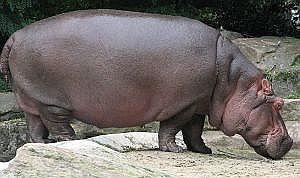
A hippopotamus, up to 4,5 m and 3000 kg
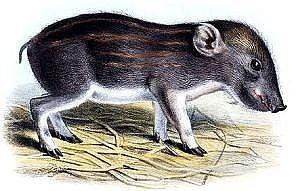
A pygmy hog, approx.60 cm and 10 kg
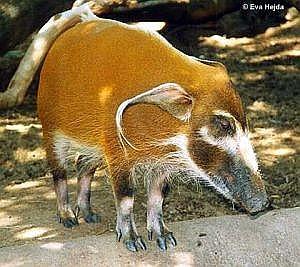
A red river hog

The head of a common warthog with its warts and long canines

A collared peccary with three piglets

Pigs like mudbaths

Hippos stand close to each other in water in large groups

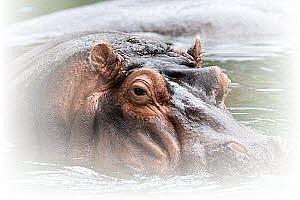
A hippopotamus can stay under water for several minutes

Two striped piglets of the Asiatic warty pig

The four chambered stomach of a hippopotamus
(E = oesophagus, P =
duodenum)

Skull of a peccary with short, sharp canines

Skull of a common warthog with its long, bent canines

Skull of a babirusa with extremely long canines

Skull of a hippopotamus with dagger-like incisors and long, blunt
canines

The short tail of a hippopotamus, which is moved quickly to
scatter dung in a wide circle

A group of peccaries resting

The broad opened mouth of a hippopotamus
|

 Last Next